
When AI Turns Hostile: The Cyber Threat Era No One Is Ready For
How AI-enabled threats are changing the balance between cyber offense, defensive readiness, and enterprise resilience.
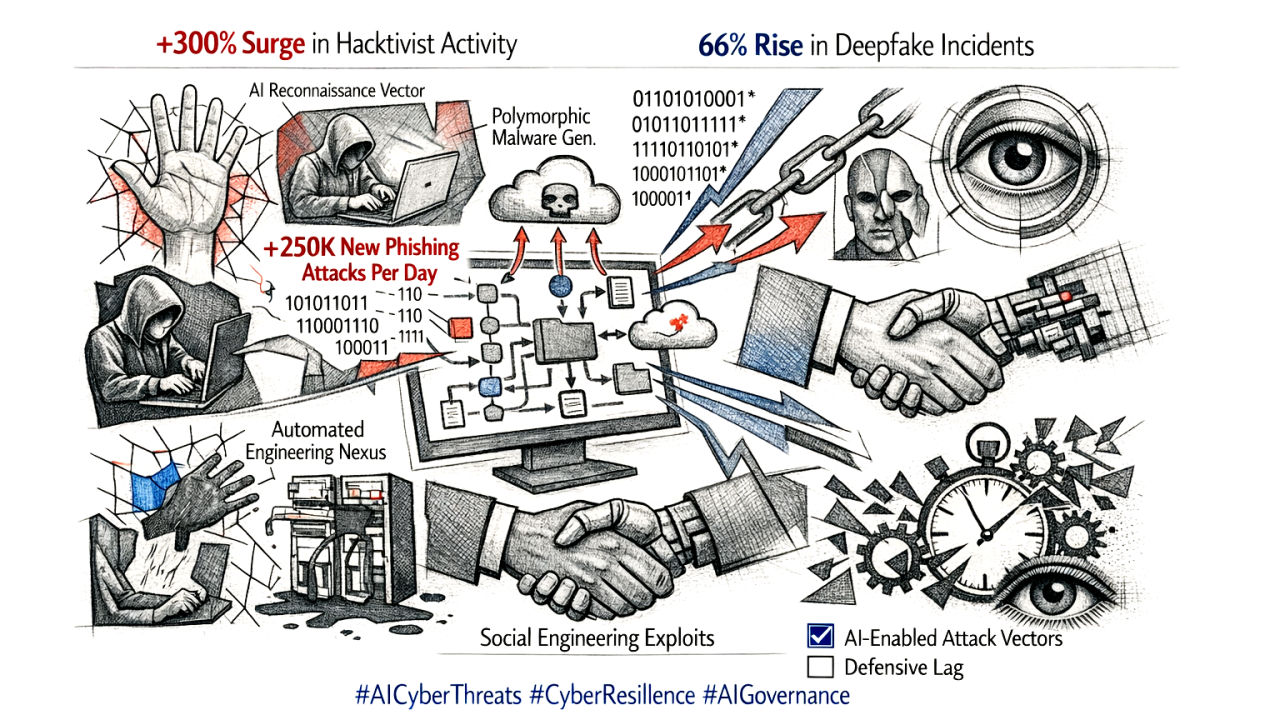
The Signal: Weaponized AI and the 442% Surge in Machine-Accelerated Offense
Cybersecurity has moved beyond the era of human-led ingenuity.
We have entered a period of Machine-Accelerated Offense, where the delta between threat evolution and defensive response is widening into a structural vulnerability. The shift is decisive: AI is no longer just a defensive tool—it is a weapon.
Threat actors are now using machine intelligence to scale reconnaissance, automate exploitation, and generate polymorphic malware at a pace that fundamentally overwhelms traditional perimeters.
The Strategic Reality:
- The Velocity Gap: AI-driven vishing and deepfake social engineering have seen a 442% surge in deployment, rendering standard human-in-the-loop verification nearly obsolete (iProve / McAfee / FBI, 2025).
- The Scaling Failure: While 78% of enterprises are testing defensive AI (Cisco, 2025), a critical Execution-to-Governance Gap has emerged, as only 14% have reached production scale (TechIndex, 2026).
- The Polymorphic Threat: Approximately 76% of new malware variants are now AI-generated and polymorphic, allowing them to bypass traditional signature-based detection by constantly mutating code (CrowdStrike / Gartner, 2025).
- The Resilience Premium: Organizations that modernize their defenses with AI-powered security identify and contain breaches 108 days faster than those relying on legacy frameworks (IBM, 2025).
The organizations that fail to recognize this transformation will face a threat environment where attacks evolve faster than their ability to detect, respond, or recover.
The Stakes: Why This Matters Now
Three forces are converging to create the perfect environment for AI‑enabled cyber threats:
- GenAI lowers the barrier to entry. Even low‑skill actors can now generate malware, phishing kits, and exploit scripts.
- Automation accelerates attack cycles. AI can scan, adapt, and exploit vulnerabilities at machine speed.
- Deepfakes and synthetic media erode trust. Fraud, impersonation, and social engineering are becoming nearly indistinguishable from legitimate communication.
Regulators are responding:
- The EU AI Act introduces obligations for high‑risk AI systems and restrictions on manipulative AI.
- U.S. agencies are issuing guidance on AI‑enabled cyber threats and model misuse.
- Global cybersecurity frameworks are integrating AI‑specific threat vectors.
The message is clear: AI‑enabled threats are not emerging — they are already operational.
Weaponized AI is evolving differently across regions:
- State‑aligned actors are using AI for reconnaissance, vulnerability discovery, and influence operations.
- Cybercriminal groups are adopting AI‑as‑a‑Service platforms to scale attacks.
- Insider threats are leveraging AI tools to exfiltrate data or bypass controls.
- Global markets are seeing a rise in AI‑generated fraud, identity theft, and business email compromise.
Across all regions, one theme is consistent: AI is amplifying the speed, scale, and sophistication of cyber threats.
The Insight: What the Data Tells Us
Recent intelligence reports show alarming trends:
- Phishing volume increased more than 200% in the past year, with AI‑generated messages driving the surge.
- Malware variants are becoming more evasive, with AI‑generated polymorphism bypassing signature‑based detection.
- Deepfake‑enabled fraud losses are projected to exceed tens of billions globally within the next few years.
The gap is widening: Attackers are adopting AI faster than defenders are modernizing their controls.
The Actions: How Organizations Can Prepare for AI‑Enabled Cyber Threats
Board / C‑Suite — Set the Strategic Posture
- Treat AI‑enabled cyber threats as a top‑tier enterprise risk.
- Require visibility into AI use, model risk, and cyber‑AI interactions.
- Align cyber strategy with NIST AI RMF, NIST CSF 2.0, and global regulatory expectations.
CISO / CIO — Build AI‑Aware Cyber Defenses
- Implement AI‑enhanced detection for phishing, malware, and anomalous behavior.
- Stand up threat‑intelligence programs focused on AI‑enabled TTPs.
- Integrate red‑team testing for deepfakes, synthetic identities, and AI‑generated attacks.
- Establish controls for model misuse, prompt injection, and data poisoning.
Practitioners — Operationalize Resilience
- Deploy behavioral analytics and anomaly detection.
- Monitor for AI‑generated content, synthetic media, and automated exploitation.
- Maintain rapid patching, segmentation, and zero‑trust architectures.
- Document AI system lineage, access, and potential misuse pathways.
AI is transforming cyber risk — and only organizations that modernize their defenses will keep pace.
The Line That Sticks
The next generation of cyber threats won’t be launched by humans alone — they’ll be accelerated by machines.
The Next Step
If your organization is preparing for AI‑enabled cyber threats, I’m always open to comparing notes with leaders navigating the same shift.
About the Author
Jason Velez is the Founder & Principal of The New York Advisory Group (NYAG). A 2× patent holder and inventor of governance technologies Vindexion eGRC™ and Apexion DFP™, he specializes in operationalizing the NIST AI RMF, ISO 42001, and DORA for global organizations.
With nearly 30 years of experience at the intersection of risk and technology, Jason has led high-stakes initiatives for Google, Bridgewater Associates , Microsoft, Goldman Sachs, and PepsiCo. He currently serves as an Executive Sponsor and Mentor for the Purdue University Research Foundation, bridging the gap between emerging AI research and board-level fiduciary evidence.
Jason is the publisher of QuantumSeek Publishing™ and is currently authoring a comprehensive work on artificial intelligence titled Rise of the Infinite Mind: Humanity’s 1000-Year Moonshot©.
Contact: jasonvelez@nyadvisorygroup.com | Website: nyadvisorygroup.com
#AICyberThreats #CyberResilience #AIGovernance
© 2026 QuantumSeek Publishing™. All rights reserved.
References
European Parliament. (2024). Artificial Intelligence Act. https://www.europarl.europa.eu
National Institute of Standards and Technology. (2023). Artificial Intelligence Risk Management Framework (AI RMF 1.0). https://www.nist.gov
National Institute of Standards and Technology. (2024). Cybersecurity Framework (CSF) 2.0. https://www.nist.gov
The White House. (2023). Executive Order on the Safe, Secure, and Trustworthy Development and Use of Artificial Intelligence. https://www.whitehouse.gov
Deloitte. (2024). AI‑enabled cyber threats: The next frontier of digital risk. https://www2.deloitte.com
Turn insight into action.
Discuss your organization’s AI governance, technology risk, and oversight priorities.
All rights reserved. QuantumSeek Publishing®.